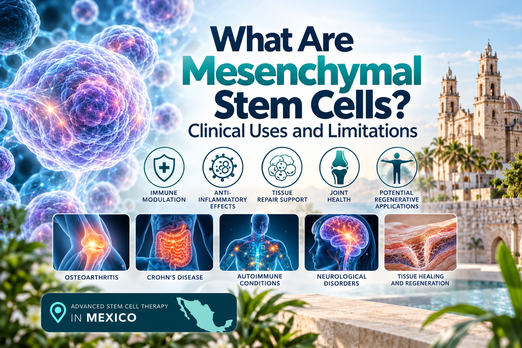
# Stem Cell Therapy for Knee Osteoarthritis: What Patients Should Know
Knee osteoarthritis is one of the most common causes of chronic knee pain, stiffness, and reduced mobility. As cartilage wears down and the joint becomes inflamed, everyday activities such as walking, climbing stairs, exercising, or standing for long periods can become more difficult.
Because conventional treatments do not always provide enough relief, interest in regenerative medicine — especially mesenchymal stromal/stem cell therapy — has increased significantly.
But what does the current evidence actually show?
## What Is Knee Osteoarthritis?
Knee osteoarthritis is a degenerative joint condition involving changes in cartilage, bone, synovial tissue, and other structures within the knee.
Common symptoms include:
* Knee pain
* Stiffness
* Swelling
* Reduced range of motion
* Grinding or clicking
* Difficulty walking or climbing stairs
* Reduced ability to exercise
Treatment usually begins with approaches such as weight management, physical therapy, exercise, anti-inflammatory medications, injections, and other non-surgical therapies.
For advanced disease, knee replacement may eventually be considered.
## What Is Stem Cell Therapy for Knee Osteoarthritis?
Most regenerative treatments marketed as “stem cell therapy” for knee osteoarthritis involve mesenchymal stromal cells, commonly called MSCs.
These cells may come from sources such as:
* Bone marrow
* Adipose tissue
* Umbilical-cord-associated tissue
* Other perinatal tissues
Rather than simply transforming into new cartilage, much of the current scientific interest focuses on the signaling molecules released by MSCs.
These signals may influence:
* Inflammatory pathways
* Immune activity
* Tissue repair
* Growth-factor signaling
* Cellular communication within the joint
This means MSC therapy should not be described simply as “injecting new cartilage cells into the knee.”
## What Does the Current Research Show?
Recent randomized controlled trials and systematic reviews suggest that intra-articular MSC therapy may reduce pain and improve function in some patients with knee osteoarthritis.
A 2025 meta-analysis of randomized controlled trials found improvements in pain and functional outcomes after MSC injections compared with control treatments. ([PubMed][1])
Another systematic review of 25 randomized trials involving more than 1,000 patients found improvements in pain scores compared with viscosupplementation, although the authors emphasized that stronger evidence is still needed because studies vary substantially in cell source, dose, preparation, and treatment protocols. ([PubMed][2])
A newer 2026 meta-analysis of 28 randomized trials also found improvements in several pain and functional measures. However, MRI outcomes did not show consistent structural improvement, meaning symptom improvement should not automatically be interpreted as proven cartilage regeneration. ([PubMed][3])
## Can Stem Cells Regrow Knee Cartilage?
This is one of the most important questions patients ask.
At this time, there is not enough consistent clinical evidence to say that stem cell injections reliably regenerate substantial amounts of damaged knee cartilage.
Some studies have reported changes on MRI or biological markers, but structural results remain inconsistent.
The strongest current evidence is more supportive of potential improvements in:
* Pain
* Function
* Mobility
* Quality of life
rather than guaranteed restoration of cartilage.
Clinics claiming that a stem cell injection will definitely “regrow your knee” or reverse severe arthritis should be approached cautiously.
## Who May Be a Candidate?
Potential candidates may include patients with mild to moderate knee osteoarthritis who continue to have symptoms despite conservative treatment.
Factors physicians may consider include:
* Severity of osteoarthritis
* Age
* Weight
* Knee alignment
* Activity level
* Previous treatments
* Meniscus or ligament damage
* Overall medical condition
* Degree of cartilage loss
Stem cell therapy may be less likely to provide meaningful benefit in patients with severe joint destruction, major deformity, or advanced bone-on-bone disease.
A proper orthopedic evaluation is important before deciding whether regenerative treatment is reasonable.
## Does Cell Source Matter?
Possibly.
Studies use different types of MSC preparations, including cells derived from bone marrow, adipose tissue, and donor tissues.
These products are not automatically equivalent.
Researchers are still investigating how factors such as:
* Cell source
* Cell dose
* Cell viability
* Culture expansion
* Number of injections
* Patient age
* Disease severity
affect outcomes.
A 2026 review found that outcomes varied depending on preparation and treatment characteristics, illustrating why simply comparing clinics by advertised “cell count” can be misleading. ([PubMed][3])
## Is More Stem Cells Always Better?
No.
There is no universally established dose that is best for every patient with knee osteoarthritis.
Some studies use relatively modest doses, while others use much larger numbers of cells.
The quality and biological characteristics of the cells may matter as much as — or more than — the advertised number.
Patients should ask:
* What type of cells are being used?
* What is the source?
* What is the viable cell count?
* How was viability measured?
* Why was this dose selected?
* Is there published evidence supporting that dose?
## Single Injection or Multiple Treatments?
Research has examined both single and repeated MSC injections.
A 2025 network meta-analysis suggested that repeated injections may produce greater improvements in pain and function at some follow-up periods, but repeated treatments were also associated with more adverse events. ([PubMed][4])
This does not mean that multiple injections are automatically better.
Treatment frequency should be based on clinical evidence and individualized assessment rather than simply assuming that more treatment produces better results.
## What Are the Possible Risks?
Reported adverse effects in clinical studies are often relatively mild, such as temporary:
* Pain
* Swelling
* Joint stiffness
* Injection-site discomfort
However, regenerative treatments can also carry more serious risks if products are improperly collected, processed, stored, transported, or administered.
Potential concerns include:
* Infection
* Contamination
* Immune reactions
* Abnormal inflammatory responses
* Blood clots
* Injection complications
The FDA has warned that regenerative products marketed for orthopedic conditions can carry significant risks when used outside appropriate regulatory pathways. ([U.S. Food and Drug Administration][5])
## Is Stem Cell Therapy FDA Approved for Knee Osteoarthritis?
No.
The FDA states that regenerative medicine products marketed as stem cell therapies are not FDA-approved for orthopedic conditions such as knee osteoarthritis in the United States. ([U.S. Food and Drug Administration][5])
This does not mean research has stopped.
Numerous clinical trials continue to investigate MSC therapies for knee osteoarthritis, but patients should understand the difference between an investigational treatment and an FDA-approved therapy.
## What About Stem Cell Therapy in Mexico?
Mexico has its own regulatory system.
COFEPRIS regulates healthcare establishments involved in regenerative medicine, cell collection, cell banking, and the processing or supply of human cells and tissues.
In 2026, COFEPRIS continued to list specific sanitary-license categories for regenerative medicine establishments and facilities involved in extracting, analyzing, preserving, preparing, or supplying human cells and tissues. ([Gobierno de México][6])
Patients considering treatment in Mexico should evaluate both the clinic and the laboratory supplying the cells.
## Stem Cells vs. PRP for Knee Osteoarthritis
PRP and MSC therapy are different treatments.
PRP uses concentrated platelets from the patient's own blood.
MSC therapy involves living stromal cells that may influence inflammatory and regenerative signaling.
Both have been studied for knee osteoarthritis.
PRP currently has a longer clinical history in orthopedic medicine, while MSC therapy represents a more complex biological intervention with growing but less standardized evidence.
The best option depends on the patient, disease severity, previous treatments, and medical evaluation.
## Questions Patients Should Ask
Before considering stem cell therapy for knee osteoarthritis, ask:
* What type of cells are being used?
* Where do they come from?
* Is the product autologous or donor-derived?
* How many viable cells are administered?
* How is viability tested?
* What sterility testing is performed?
* What evidence supports this treatment for knee osteoarthritis?
* How many injections are recommended?
* What are the realistic expected benefits?
* What are the possible risks?
* How will progress be measured?
* What follow-up care is included?
* What regulatory authorization applies to the clinic and laboratory?
## The Bottom Line
Stem cell therapy for knee osteoarthritis is an active and increasingly studied area of regenerative medicine.
Recent randomized trials and meta-analyses suggest that MSC-based injections may improve pain and function for some patients, particularly over several months of follow-up. ([PubMed][1])
However, the evidence does not support guaranteeing cartilage regeneration, reversing advanced arthritis, or avoiding knee replacement in every patient.
Results vary because knee osteoarthritis itself varies — and so do cell sources, doses, processing methods, and patient characteristics.
Patients should approach stem cell therapy as a medical treatment requiring careful evaluation, transparent discussion of evidence, and realistic expectations rather than as a guaranteed cure.
Suggested meta title:
Stem Cell Therapy for Knee Osteoarthritis | What Patients Should Know
Suggested meta description:
Learn what current research shows about stem cell therapy for knee osteoarthritis, including MSC treatments, pain and function outcomes, cartilage regeneration, risks, patient selection, and treatment in Mexico.
[1]: https://pubmed.ncbi.nlm.nih.gov/40055739/?utm_source=chatgpt.com "Efficacy and safety of mesenchymal stem cells in knee osteoarthritis: a systematic review and meta-analysis of randomized controlled trials - PubMed"
[2]: https://pubmed.ncbi.nlm.nih.gov/39360004/?utm_source=chatgpt.com "Advanced therapy with mesenchymal stromal cells for knee osteoarthritis: Systematic review and meta-analysis of randomized controlled trials - PubMed"
[3]: https://pubmed.ncbi.nlm.nih.gov/41863718/?utm_source=chatgpt.com "Efficacy and safety of intra-articular mesenchymal stem cell-based therapies in knee osteoarthritis: A systematic review and meta-analysis of randomized controlled trials - PubMed"
[4]: https://pubmed.ncbi.nlm.nih.gov/41013772/?utm_source=chatgpt.com "Efficacy and safety of single versus repeated injections of mesenchymal stem cells for the treatment of knee osteoarthritis: a systematic review and network meta-analysis of randomized controlled trials - PubMed"
[5]: https://www.fda.gov/vaccines-blood-biologics/consumers-biologics/consumer-alert-regenerative-medicine-products-including-stem-cells-and-exosomes?utm_source=chatgpt.com "Consumer Alert on Regenerative Medicine Products Including Stem Cells and Exosomes | FDA"
[6]: https://www.gob.mx/cofepris/acciones-y-programas/licencia-sanitaria-de-servicios-de-salud-nuevo?utm_source=chatgpt.com "Licencia Sanitaria de Servicios de Salud Nuevo | Comisión Federal para la Protección contra Riesgos Sanitarios | Gobierno | gob.mx"